

Nostalgia, Ultra
Cracker Barrel Theories pt. II

If you can believe it, I actually have more to say about the whole Cracker Barrel branding fiasco, albeit this time it’s less about culture war skirmishes and more about being an American. So if that’s interests you at all, buckle up. If not, that’s fine too. Just click the subscribe button on your way out. (But if you leave now you’ll miss a bunch of good quotes from Jameson and Kierkegaard.)
My brain started sputtering to life after I read a note that
wrote in response to Ted Gioia—I will not tag him because I think he’s, generally, very dumb about politics and culture—who was telling people to just go to a local southern restaurant instead of a massive publicly traded chain. Dee made the salient point that the reason people are upset is not because they consider it an authentic representation of culture, but rather because Cracker Barrel and its ilk “traffic in nostalgia.” In that way, these places are less like meaningless, self-referential simulacrums and more like externalized stores of memory, both synthesized and real. You don’t have to have made a memory in a literal Cracker Barrel to feel a twinge of loss when something consistent like a logo changes; it’s enough that you associate some sort of chain restaurant with a specific moment or era of your life.I still believe that the actual conflagration over the Cracker Barrel logo was mostly a bad faith reactionary psyop, but what I didn’t get to in that initial read on the situation was that thinking about how Americans have a very deep and potentially unique connection to commercial enterprises and brands. When Guy Debord wrote that “the image has become the final form of commodity reification” he was more referring to media than corporate logos, but I’d argue that Americans do make their favorite brands into something approaching a figure of worship1,2. Stanley Cups, Labubus, Alo sets, sure, but also the idea of McDonald’s and Costco and Starbucks as quintessential to the American identity more so than a sense of community between local and national neighbors. Reactionaries have incorrectly blamed that disintegration on immigration and non-white people, but the American desire to consume has become so dominant that the consumer is quite literally the national identity.
Nostalgia is an important part of all that and, somewhat counterintuitively, maybe, it also serves as a reason why people are apparently pissed off about the whole Cracker Barrel thing. “Memory is above all the distinctive element of the unhappy ones, which is natural, because the past has the notable characteristic that it is gone; future time, that it is yet to come,” Kierkegaard wrote in “The Unhappiest One” from Either/Or. It is in that temporality that people find a deep well of unhappiness, especially if they are reminded of how those memories are shadows. The Baudrillardian theory—and I am a huge Baudrillard head—of vacant semiotics is observing this phenomenon from a distant detachment. He’s not eating the pancakes or the biscuits or buying the Lodge Cast Iron in the gift shop. Those people don’t care that Cracker Barrel isn’t actually referring to anything but itself or a fabricated vision of American history. The simulacrum is where you had your 12th birthday, and that makes it real enough.
Jameson called this nostalgia’s “insensible colonization of the present,” "where “the desperate attempt to appropriate a missing past is now refracted through the iron law of fashion change.” It’s not as if people are actually reminded me walking into their pawpaw’s general store by entering a Cracker Barrel, but that they know they should feel some phantom pang of recollection, like a collective déjà vu. But reference also degrades, like when a file gets passed around a serve one time too many times. “Faced with these ultimate objects—our social, historical and existential present, and the past as ‘referent’—the incompatibility of a postmodernist ‘nostalgia’ art language with genuine historicity becomes dramatically apparent,” Jameson wrote. I’m not calling the Cracker Barrel logo art, exactly, but it is something we consume and develop associations with and is therefore a presence in American culture.
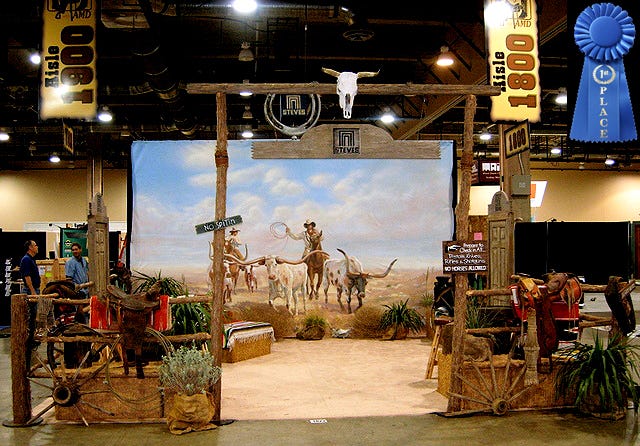
Americans are potentially unique in their attachment to nostalgia because there are so few “real” historical objects or traditions with which to commune. I was talking to Olivia Ciacci (
) about whether or not Europeans seem to experience nostalgia in the same Americans do, and it occurs to me that Germans, say, are able to go to something like a beer hall and have the surroundings have a sturdy set of semiotic meanings. Even if we use one of the most widely referenced and easily distinguishable pieces of specifically American heritage (the Cowboy / Wild West), modern attempts to make it in a nostalgic trend take it further away from actual meaning. See: the growing number of honky tonks in Brooklyn and Manhattan catering to people who have never been on a horse before.The revanchist nostalgia that drives so much of MAGA (and Retvrn-ass European thinking) has similar headwaters to the gentler streams of cowboy cosplay. Kierkegaard did most of his work before nostalgia was a commonly used term; ‘longing’ seemed more familiar and expressed a desire for a contemporaneous thing or place, rather than another time3. But he still meditated on how memories can be a corrupting force if you attempt to resurrect them in the present4. “Thus, what [the Unhappiest One] is hoping for lies behind him; what he recollects lies ahead of him. His life is not backwards but is turned the wrong way in two directions. He will soon perceive his trouble even though he does not comprehend the reason for it.” There is a sort of infinite introspection to nostalgia for Kierkegaard, which actually meshes decently well with Baudrillard’s concept of simulacra and self-referential objects.
Writing a century later, when “nostalgia” had become fully entrenched in common usage, J.G. Hart is slightly more direct. “The nostalgic return to childhood is a return to the aurora of springtime, the dawn of hope It is a return to the time when the wishes and hopes which constitute our present were fresh and before the wishes and hopes were battered and bruised,” he wrote in Towards a Phenomenology of Nostalgia in 1973. The scar tissue there is resentment, not for some national betrayal but that the one dependable thing in an American’s life—a commercial brand—was made unpredictable.
Right before I scribbled out these thoughts, I was reading
’s beautiful essay about Devo and LCD Soundsystem, and their “conceptual cohesion” or lack thereof. It is a sort of Baudrillardian line of thinking, that someone like James Murphy was making empty references to “being there” as a sort of winking admission of his own out-of-placeness. In his typically beautiful way, though, Carl brings the abstract down to earth":So now Chris and I were there, 20 years after that song came out, at the aptly named History, a venue that didn’t exist then, surrounded by millennials expressing their nostalgia for Murphy’s nostalgia. Which is our nostalgia, as his contemporaries, but as noted above, that’s already partly a yearning for a previous generation’s nostalgia. And the millennials were interspersed with even younger people who I guess were yearning for the millennials’ nostalgia. Mirrors within mirrors, regressing.
Turtles all the way down, indeed. I do wonder sometimes what it means to get weepy at a song like “All My Friends,” where it feels like Murphy is some sort of externalized memory machine, a dialytic nostalgia. “For there he stands,” Kierkegaard wrote. “[T]he envoy from the kingdom of sighs, the chosen favorite of suffering, the apostle of grief, the silent friend of pain, the unhappy lover of recollection, confused in his recollection by the light of hope, frustrated in his hope by the ghosts of recollection.”
In this way, we can also explain the dynamic of celebrities/musicians as brands and the emergence of stan culture, which is absolutely a form of psychosis.
And not to get too DFW on everyone with these footnotes, but even that word “reification” is interesting in the context of all of this when you consider something, like, say, Britain’s tradition of televised/publicized Royal Wedding and the upcoming nuptials of Taylor Swift and Travis Kelce who are both immediate brands in themselves but also avatars of larger forces in music and sports in American culture that supersede national bonds. The Royal Family—and I say this as an abolitionist—does represent something very specific beyond capital, which is why, I think, everyone was so irritated by Meghan Markle, who saw her position from an American perspective, i.e. a commercial one. (I also think she would be allowed to be this obnoxious without quite this relentless of negative press coverage if she were white.) There is a bit of what Fredric Jameson talked about in Postmodernism at play here, albeit it’s more theoretical than actual: “[T]he producers of culture have nowhere to turn but to the past: the imitation of dead styles, speech through all the masks and voices stored up in the imaginary museum of a now global culture.” Kelce and Swift represent a kind of American royalty, but because our traditions are both inculcated and devoured by commercialism, it’s a flimsy conceit mostly represented by that “imaginary museum” of self-referential, often nostalgic symbols: the gym / english teacher, the cheerleader / captain of the football team, the lovable lunk / relatable every girl.
I’m sort of curious if someone from the 18th century was ever like “man, I bet shit was so much better in the 17th century.”
In this way Kierkegaard had formed a sort of syncretic theology by grafting one of Buddhism’s core tenets to a theory of Christian existentialism.
Which is our nostalgia, as his contemporaries, but as noted above, that’s already partly a yearning for a previous generation’s nostalgia. And the millennials were interspersed with even younger people who I guess were yearning for the millennials’ nostalgia. Mirrors within mirrors, regressing. <-- this is something that's particularly present on Tiktok but then, I guess the '90s were a yearning for the '60s and '70s, so on and so forth.
This is fabulous - I have to go read that full Kierkegaard essay now. Thank you for all the ridiculously flattering things. ... I think along with their symbolic-nostalgia value people also attach to corporate identities as just *landmarks, both geographic and semiotic-media ones. I have never been to a Cracker Barrel in my life, but from the old logo I got what it was supposed to represent (the dark side of "cracker" included) and the new logo just voided all that information (as surely was its intent). So the part of my brain that has a meaning attached to Cracker Barrel-ness thinks, "Well, what's the use of you now?" and feels a small deflation.