

Casino Sociale
How gambling is warping our shared concept of reality

This essay was originally commissioned almost a year ago and, sadly, didn’t work out with its intended publisher. Some of the arguments and observations were fresher and somewhat original when I first started working on this piece, but like so many works of cultural criticism, it is not as if I was alone in observing what was going on in the world. Significant parts of this essay were changed every few months when yet another watershed moment—Polymarket’s war prediction markets, insider trading scandals on sports prop bets—hit the news. I mean, 24 hours ago there was a chance that someone had insider info on a potential pullback in American military operations in Iran and walked away with a ton of money on an oil futures trade. But here is my long take on why the ubiquity of gambling is reshaping our sense of reality and why that matters. Huge thanks to Jon Baskin and Ed Park for giving this piece a read, and to Emily Sundberg, Delia Cai, and Peter C. Baker for the advice on what to do with a homeless essay this long. And peace to the editors who might read this and wince, it needed some work but I was also tired of looking at it.

In Addiction by Design, Natasha D. Schüll’s compelling history and analysis of slot machine gamblers in Las Vegas, she describes the “machine zone” where players go into a cocooned hypnosis when they sit in front of a set of reels. Slot machine gambling provided one person Schüll talked to “a reliable mechanism for securing a zone of insulation from a ‘human world’ she experiences as capricious, discontinuous, and insecure.” Rather than the prospect of winning enough money to feel secure, gambling itself became the belief system. “The continuity of machine gambling holds worldly contingencies in a kind of abeyance, granting her an otherwise elusive zone of certainty,” Schüll wrote. The promise was agency through risk; the reality is grim dissociation. The casino economy has become a sort of inescapable cocoon where one discovers that the real comfort isn’t in winning, but in the suspension of having to live in the world at all.

Schüll’s conclusions have some philosophical forebears. In his 1981 book Simulacra and Simulation, the philosopher Jean Baudrillard described a “hyperreality” where symbols became increasingly separate from and paramount to their associated meanings. Prediction markets are a hyperreal development, whereby information starts to shape outcomes like water carving its way through earth. They create the news and then commodify it, turning events into markets and assigning a dollar value to them. When someone bets on, say, whether Israel will attack Lebanon, that person ceases to care about the actual event in a real way — about the people who might be hurt, or about the wider geopolitical implications — and are only interested in the outcome as it affects their wager. “Information is thought to create communication, and even if the waste is enormous, a general consensus would have it that nevertheless, as a whole, there be an excess of meaning,” Baudrillard wrote. “We are all complicitous in this myth. It is the alpha and omega of our modernity, without which the credibility of our social organization would collapse. Well, the fact is that it is collapsing, and for this very reason: because where we think that information produces meaning, the opposite occurs.” Instead, information now creates markets.
But, since we’re in America, we should talk about football instead of French postmodernism. Since the National Football League’s existence, its leaders have fought to keep sports betting limited to Las Vegas and the black-market domain of private bookies. “Legalized sports gambling sends a regrettable message to our young people that states might as well legalize, sponsor, and promote any activity to get a ‘cut,’” commissioner Paul Tagliabue said in 1991. The NFL was meant to be a moral beacon for Americans; the league was so dedicated to limiting the practice that they even crossed international borders to root out gambling networks.
In 1998, the director of Antigua’s offshore gaming office told Sports Illustrated that she wanted the country to become the “Las Vegas of internet gambling.” By the end of the decade, 80 percent of all gaming websites — including online casinos and sports betting pages — were run on servers in the island nation. After securing $500,000 in startup capital, an American banker named Jay Cohen moved to Antigua and set up a betting site called World Sports Exchange, or www.wsex.com. He found that sports betting markets behaved like the stock market, with speculators piling into risky bets hoping for a big payoff. “If you go to our website and you change ‘Boston Red Sox’ to ‘Boston Market,’ we’re Ameritrade,” he was apparently fond of saying.
All that money floating down digital currents to the Caribbean eventually caught the attention of the NFL and its high-powered lawyers, who hit WSEX with a cease-and-desist order and started lobbying federal prosecutors to pursue a case against the platform’s operators. The Southern District of New York eventually indicted Cohen on violations of the Federal Wire Act. He turned himself in, convinced that the case was weak, and was convicted in 2000, the first — but certainly not the last — person to be put away by the USDOJ for running an offshore internet betting operation. WSEX continued operating until 2006, when George W. Bush signed the Unlawful Internet Gambling Enforcement Act, which made it so reputable wire transfer services like Western Union wouldn’t process payments between the platform and its players. The law effectively killed WSEX, and with it Americans’ ability to bet on sports.
The NFL’s position on gambling remained the same for nearly two decades: that it represented a grave danger to the league that would open the floodgates to corruption and scandal. In 2012, when Tagliabue’s successor Roger Goodell was asked during a deposition “what threats are there to the integrity of pro football in the United States?” his answer was unequivocal: “Gambling would be No. 1 on my list.” Then, in a landmark 2018 decision, the Supreme Court ruled against a collection of major sports leagues — including the NFL, MLB, and NBA — that had sued New Jersey Governor Chris Christie over his decision to permit sports betting in his state. The ruling struck down a law that had severely limited sports betting and, suddenly, the NFL saw an opportunity for profit where previously it only saw a corrupting force. “The NFL doesn’t leave a lot of money on the table,” Jacksonville Jaguars owner Shad Khan explained of the league’s apparent change of heart in 2021. Goodell and the NFL brokered official partnerships with online sports betting platforms like DraftKings and FanDuel worth more than a billion dollars. “We have to adapt. We have to embrace it,” Goodell said of sports betting ahead of the Super Bowl in 2024 –– appropriately enough, the first one to be held in Las Vegas, where the league had enthusiastically relocated a franchise.
Legal bettors were projected to drop $35 billion on football games last season, while the betting houses themselves spent nearly half a billion dollars on ads, almost all concentrated on the commercial breaks during games. Gambling went from radioactive to essential in short order, shilled during timeouts by Jamie Foxx and Tony Hawk. Professional oddsmakers evolved from cigar-chewing swamis reading weather reports and quarterback blind items into data science PhDs using complex algorithmic models to dictate points spreads. The entire gambling ecosystem was granted the imprimatur of the NFL, its shield emblem printed alongside sportsbooks logos with legally mandated language about getting help for gambling addiction typed out anemically right below.
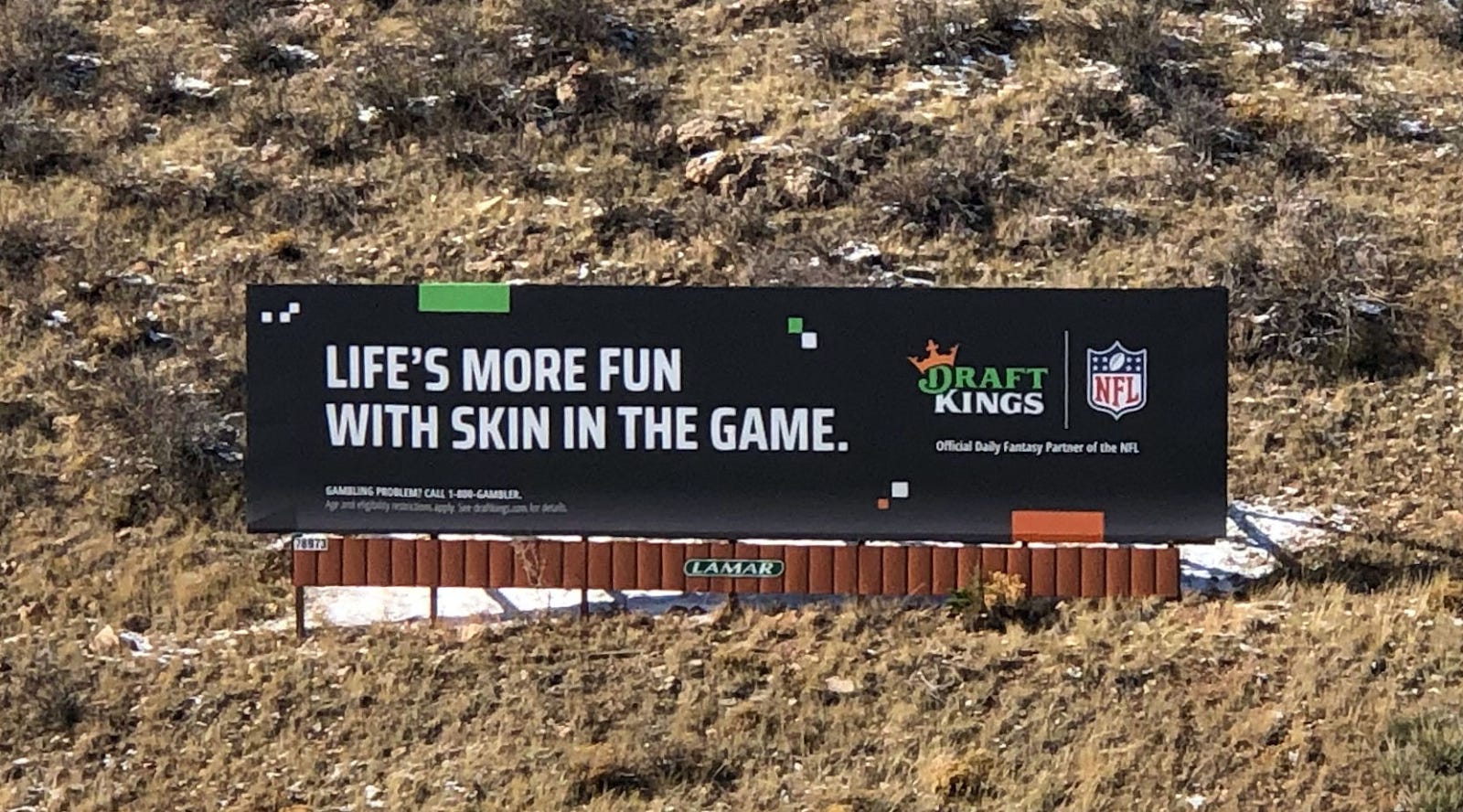
The spread of modern sports gambling has introduced a casualness to what used to be a more focused exercise. You used to have to go somewhere — Las Vegas or, say, Delaware — or call a bookie. Now with a few taps you can bet whether a run will be scored in a given inning in baseball, who will double fault first at a match in Wimbledon, or how many points an NBA player will score in the first three minutes of a game. It is a total data-based atomization of what used to be a communal experience. Many people watching sports games now only see them in terms of discrete, individualized outcomes, a series of binaries that will win or lose them money. There are entire segments about betting odds during broadcasts of games, with live odds and exotic same-game parlays posted alongside the score bugs, just in case you get bored watching and need to plunk a few dollars down on something.
It is a total data-based atomization of what used to be a communal experience. Many people watching sports games now only see them in terms of discrete, individualized outcomes, a series of binaries that will win or lose them money.
And it’s not just sports that people want to bet on. “Prediction platforms” like Polymarket and Kalshi are entrenching themselves deeper into American sociopolitical life. Users can bet anything from “will Trump acquire Greenland before 2027?” (the jury is still out) and “Khamenei out as Supreme Leader of Iran by January 31?” (you were just too early!) “If you wanted a single best predictor, one source of information to know what’s going on in the elections, it’s the prediction market,” a Rutgers statistics professor told CNN ahead of the 2024 presidential election, an event that seemed to prove that thesis. Many nationally reputable polls had the 2024 race as a dead heat; Polymarket had Trump’s chances at 60 percent. In December 2025, Kalshi signed an agreement with CNN that will, per a press release, allow the news network to “surface credible information to their audiences about the real-time probabilities of future cultural and political events.” The odds, in other words, are becoming the truth themselves, with “a new Kalshi-powered real-time news ticker” to deliver up-to-the-moment updates.
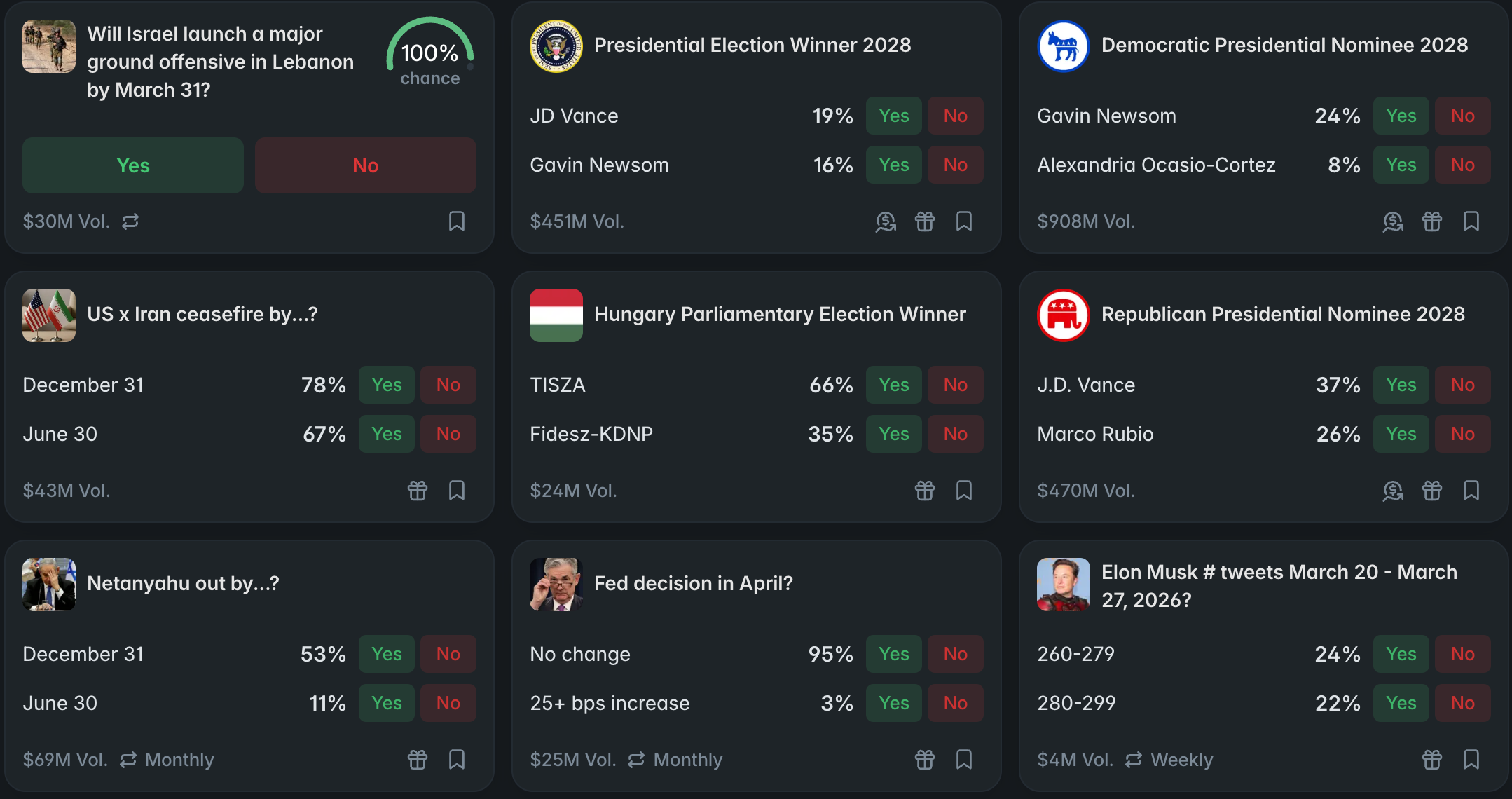
Betting on future political outcomes alters our sense of reality so that everything is filtered through the idea of financial gains and losses. Prediction markets are incentivization machines. Placing bets on political outcomes in order to win money turns information into a market where people are motivated to hope for one outcome over another. In that way, the truth becomes whatever the most people want to win. The indispensable economics commentator kyla scanlon calls the total entrenchment of betting in American life the “casino economy,” positioning symptoms like frictionless trading platforms, dating apps, and AI bots that read resumes as drivers of “zero-sum thinking” among young people who are increasingly hopeless. “In a true market, skill creates value,” she writes. “The casino economy is about simulated fairness masking an imbalance. Everyone feels like they could win — and this structure thrives on hope just long enough to drain it.” In other words, because returns on pursuits like education and climbing the corporate ladder aren’t guaranteed, people are more willing to tolerate risk – and even shove their chips onto bets that might give them ways out. Scanlon comprehensively explains the economic mechanics at play, but there is a stranger social phenomenon happening where young people are increasingly having their realities shaped by the outcomes of bets and not just the contents of their bank accounts.
The economics are vital to understanding this dynamic, though, so let’s talk about them. Americans spend more than $100 billion on lottery tickets every year, with people living in the poorest zip codes spending four times as much as those living in the richest. “They’re hoping to pay their rent at the end of the month or pay an outstanding medical bill or put their kids through college or they just lost their job and they’re just trying to find a way to make ends meet,” Les Bernal, the national director of the nonprofit Stop Predatory Gambling, told CNN in 2022. “And here you have what is a government program encouraging citizens to lose their money on rigged games.”
Gambling also doesn’t seem to stick to a single income bracket, either. At the U.S. Open last summer, I sat behind a group of young men in the mezzanine at Arthur Ashe stadium placing bets on individual points and the number of aces in the match we were watching. Tickets in the section I was sitting cost several hundred dollars a pop, and yet these guys were buried in their phones, their Rolexes shaking slightly as they tapped into digital dopamine hits a few clicks at a time. They seemed to enjoy the bets they were placing more than the tennis itself. Unfortunately, that’s one of the major reasons for gambling’s surge in popularity: it’s really fun.
So where did that capital and desire come from? As with a lot of modern neuroses, it started during the pandemic lockdowns where there were a lot of bored people with excess cash. The Federal Reserve estimated that people saved more than twice as much as usual in 2020 and 2021 before spending at a rapid clip in the following years. With sports suspended, there wasn’t much to gamble on, and so people turned to the next best thing: the stock market. Apps like Robinhood turned investing in equities and trading options into something as easy as Candy Crush, complete with cartoony animations and mobile mechanics. The interface itself is shockingly similar to sports betting apps like DraftKings and FanDuel, where the “top moving” stocks and cryptocurrencies are placed front and center as enticements for users. (Not to be outdone, Robinhood now has their own prediction market function, effectively a side door for the company to facilitate sports gambling without a gaming license.) App users were even given a free share of stock just for signing up, similar to how gambling sites will give new users free betting credits. Robinhood added over ten million users in 2020 alone, many of them first-time investors who treated the stock market like a casino because the platform made it look and feel like one.
That development hit a high-water mark during the 2021 meme stock phenomenon, where amateur traders in a subreddit called r/WallStreetBets drove up the prices of GameStop and AMC through something called a “short squeeze.” The mechanics are a little convoluted, but there are institutional investors who make money betting that a company’s stock is overvalued and “sell short,” where they’re loaned stocks at a given price for a fee. Short sellers want the stock to go down, but it’s a risky investment strategy. The longer the stock they’re betting against stays at or above the price at which the short seller borrowed, the greater the losses. (Disclosure: I piled some money into GameStop options that spring and my diamond hands ended up costing me a few grand.) “The rookies who transformed videogame retailer GameStop into the hottest stock on the planet thought they had a twofer: sticking it to Wall Street while making a bundle themselves. The revolutionaries didn’t do a good job on either count,” wrote Spencer Jakab, the author of The Revolution That Wasn’t, a book that chronicles the saga. Even for those who didn’t win big, the GameStop saga showed how closely linked casino culture is to anger over relentless financialization. One WallStreetBets member summed it up in an open letter to Melvin Capital, a hedge fund that the community had singled out. “I was in my early teens during the ‘08 crisis. I vividly remember the enormous repercussions that the reckless actions by those on Wall Street had in my personal life, and the lives of those close to me,” they wrote. “This is personal for me, and millions of others.”
Where memestocks would fail, crypto seems to have succeeded, thanks in no small part to the official imprimatur of a bullish White House and a hell of a lot of lobbying. Three crypto-friendly super PACs spent upwards of $130 million in 2024 congressional races. The money was largely courtesy of Coinbase, a large crypto trading platform. All that crypto money sloshing around Capitol Hill had material impacts. Ruben Gallego, the Democratic senator from Arizona, received $10 million from super PACs funded by large crypto companies. He won and, when a crypto-friendly bill was moving through the Senate, Gallego sided with a group of Republican senators to support it, breaking with many of his Democrat colleagues in the process. Efforts by politicians like Gallego have helped flood the market with memecoins and shitcoins, literal blockchain pump-and-dump schemes that don’t even go through the posturing of being a store of value. Something like a Trumpcoin or a Mother Iggy coin (that’s Iggy Azalea) or a Daddy coin (sigh, that’s Andrew Tate) is better thought of as a store of narrative value, as if there was a forex that exchanged on how influential a given person is on a given day. They’re unalloyed speculative instruments whose value derives entirely from the maxim “line goes up.”
Still, somehow, hundreds of billions of dollars have been spent on meme coins because the potential upside is too enticing for a lot of risk eaters to ignore, even if the odds are stacked against them. There are entire private communities on messaging apps like Telegram and Discord that cheerfully coordinate crypto pump-and-dumps, where groups run up the price of a given currency and sell it before it crashes back to earth. Some of the conspiracies aren’t particularly clandestine: in 2022, researchers at Chainanalysis estimated that a quarter of all new coins launched were scams and found that being brazen about the mechanics was actually better than obscuring the whole thing. Pumps are quite lucrative as well; one analysis that scammers took home $241.6 million worth of profits off suspects pump-and-dumps in 2023. Five months after Trump released his own memecoin, research found that 56 wallets had made a total profit of $1.1 billion while 764,000 others lost money. The journalist Jacob Silverman called Trump’s crypto dealings “the largest act of financial corruption in presidential history.”
That illusion of potential escape provided by these scams is alluring, and causes people to miscalculate their odds. A report from J.P. Morgan found that “most individuals who transferred money to crypto accounts did so when crypto-asset prices were significantly higher than recent levels,” suggesting that a lot of people were simply trying to get in on a gold rush. The results were even starker for poor people. “Those with lower incomes likely made purchases at elevated prices relative to higher earners,” the bank researchers found, which means that often poorer people who saw a potential exit route — or at least temporary reprieve — from their economic situation were left in the lurch when crypto prices crashed. Young people who have absorbed the liberatory promises of the modern internet are especially willing to bet on crypto. A 2025 YouGov survey found that Gen Z is four times more likely to own crypto than a retirement fund, signaling both appetite for risk and reduced trust in the long-term viability of institutions to take care of them as they age. Crypto, then, is both a path to financial and personal empowerment, which gives it a layered appeal. “You talk to anybody under 25, and they’ve been told that crypto is their freedom,” Anil Dash told the New York Times in 2022.
Both the Gamestop retail trading phenomenon and cryptocurrency have something in common: the ability to leverage attention into material gains. That is the ultimate goal of anyone hoping to use the casino culture to their advantage. When memecoin boosters pay celebrities to endorse their shoddy crypto, it’s not because they believe in the integrity of blockchain technology or that Fartcoin could be an inflationary hedge. Rather, they’re attempting to convince other gamblers to pile in money to drive the price up before the people who know better can cash out their winnings and leave the rubes holding the bag. There are no market fundamentals anymore, no stock or currency prices that relate back to something approaching meaning. It’s all empty symbols that are traded back and forth.
The interweaving of gambling and culture has accelerated in the last 18 months. Kalshi’s agreement with CNN means that you’re as likely to see betting market odds as you are stringently sourced poll numbers on the news network, a development that some experts see as getting closer to what people are actually feeling. The creation of these sorts of markets can create some odd opportunities for savvy bettors. Ahead of the 2024 Presidential election, a single French trader on Polymarket wagered and won millions of dollars that Trump would win, causing concern over market manipulation. And more recently, the night before Venezuelan opposition leader María Corina Machado was awarded the Nobel Peace Prize, her odds of winning jumped from 3.6% to 73% in the course of a couple hours, which suggested that someone with inside information had leaked the committee’s decision. That information can now be readily turned into winning bets—a much safer and more efficient strategy than something like blackmail—opens the door for a whole new category of crime that prediction platforms seem uninterested in prosecuting. “It seems we have been prey to a criminal actor who wants to earn money on our information,” Kristian Berg Harpviken, the head of the Institute, told Bloomberg.

When betting markets replace polls, though, some odd things happen to people’s perceptions of reality. For however ineffective cold calling potential voters is, they also don’t incentivize any given outcome. People are asked a set of questions and the answers create a data set. The information has meaning: this many people think one way and this many people think another way. Prediction markets on the other hand are incentivization machines. Placing bets on political outcomes in order to win money turns information into a market where people are motivated to hope for one outcome over another. There is an argument to be made that by attaching risk to an opinion, you can squeeze out a more honest assessment of the world. But more likely the truth just becomes whatever the most people want to win. As the economic historian Philip Mirowski puts it: “Neoliberals have great faith in the marketplace of ideas; and for them, the truth is validated as what sells.”
But even beyond formal betting, political engagement has taken on the characteristics of gambling as well. The most revealing example of that development is the ecosystem of podcasters and media figures who have built careers by betting on cultural and political trends. Consider the trajectory of figures like Tucker Carlson, who left mainstream media to build an independent media empire based on his ability to predict and shape conservative political sentiment. Or the Nelk Boys, who transformed from prank YouTubers into political influencers by recognizing that aligning with Trump-era conservatism could expand their audience and revenue streams. Even baby-faced Nazi Nick Fuentes has started to twist in the political winds after American and Israeli bombs started falling on Iran, attempting to end run his mainstream conservative rivals by appealing to his young audience’s lack of appetite for random wars that spike gas prices. These figures represent a new type of cultural entrepreneur who treats political and cultural positioning as investment opportunities. They don’t necessarily have deep ideological commitments; instead, they have developed sophisticated abilities to identify emerging trends and position themselves to benefit from them.
When the Nelk Boys started their careers, they were your average YouTube pranksters posting videos with titles like “Coke Prank on Cops,” where one of them panickedly admits to having a trunk full of coke that turns out to be the soft drink rather than the drug. That was in 2015, and they were trying to live in an ecosystem populated with the Paul brothers and Mr. Beast. Politics weren’t interesting to them because there was no financial alignment there yet. Trump was viewed mostly as a joke.
That shifted when Trump lost reelection and MAGA became a rallying cry for a lot of irony-poisoned young men. The heat had shifted from doing stupid things for laughs to treating politics like the WWE. The Nelk Boys saw this early. In 2021, the first guest on their wildly successful podcast Full Send was Dana White, the CEO of UFC and staunch Trump supporter. The second episode featured Donald Trump Jr. as a guest. (The third guest was Shaq, which, ok.) The trick the Nelk Boys pull, though, is that they claim to be an arm’s length from seriousness at all times. After they interviewed Israeli prime minister Benjamin Netanyahu, Nelk Boy Aaron Steinberg said, “We are so not qualified to do this.”
I like to call what the Nelk Boys, as well as influencers like Jake Paul and anti-woke comedian Andrew Schulz are doing “vibes gambling.” It is not actually important whether these characters have cohesive, persistent views of the world, and in fact attempting to present some sort of nuanced political equanimity is probably bad for their particular business model. What is valuable to them is that they’re able to align themselves with a given audience for long enough to reap the benefits. They’re investing in vibes futures, buying vibe puts and vibe calls and trading them based on a fickle market that moves as sentiments shift and new shit goes viral on TikTok. When in the course of a year Carlson goes from speaking at Trump rallies during the campaign to openly criticizing the administration’s decision to drop bombs on Iran or talking about Israel’s influence on the American government, he is not going through some sort of political awakening but rather looking out across the country and seeing which ways his audience is leaning.
I like to call what the Nelk Boys, as well as influencers like Jake Paul and anti-woke comedian Andrew Schulz are doing “vibes gambling.”
The vibes gamblers and crypto speculators are playing the same game in different markets. Both have learned that in an economy where traditional pathways to stability have collapsed, the only rational response is to treat everything as a bet they can get on the end of. Political allegiances just become a path towards attention, subscriber counts, and, eventually, an exit from the threat of permanent serfdom or something like it. The casino economy is turning cynical people into cultural day traders, constantly repositioning based on which way the sentiment is moving.
At this point, you’ll have noticed that the current I’m describing seems to be overwhelmingly masculine. Men are twice as likely as women to gamble in the first place, and three times as likely to develop an addiction. Betting companies are also spending millions of dollars to advertise on college campuses, where there is a growing concern that students are getting addicted to gambling at an early age. An NCAA survey found that 67% of college students that live on campus have bet on sports, while a third of men between the ages of 18 and 22 place bets at least a few times every month. A study published in The Lancet found that 16.3% of young people who bet on sports worldwide will develop an addiction. All of these virtual worlds have given young men who are already retreating from real life a new home much like the “machine zone” that Schüll describes in her book. There are internal dynamics and physics, there are meme-filled argots that feel torn from alternate realities. There’s a political law of conservation here: as young men withdraw from one world, they enter another.
These guys have been zeroed in on by ads for sports betting over the last few years, as they’ve provided a lucrative and consistent source of revenue. The marketing tactics are meant to provoke guys into action, the not-so-subtle messaging being you’re less of a man if you don’t gamble. One BetMGM ad from 2024 begins with a suited Jamie Foxx walking on water telling viewers, “It’s time to turn talk into action. Step 1: fire up your BetMGM sportsbook.” The gendered dimension to these tactics reflects broader anxieties about how stereotypically masculine pathways to success have disappeared. The popular modern concept of masculinity is fused to risk: men take on risky jobs in construction or mining, they go to war, they drive motorcycles and go hunting. In Erving Goffman’s study of masculinity and risk takers, Where the Action Is, the anthropologist and sometime professional blackjack dealer wrote that part of Las Vegas’ comfort with gambling is actually a direct result of the state’s silver mining history. “The argument is that since the economy of the state itself was founded on gambles with the ground, it is understandable that casino gambling was never viewed with much disapproval,” Goffman wrote. The transformation of silver miner into poker player was a simple swap of pick and shovel for a stack of chips. Both were “action.”
But there is only one silver mine left in Nevada. The factories have closed, the wars have been fought, at least the ones that needed soldiers. “Drone operator” doesn’t have the same resonance as “fighter pilot.” The tradmasc dream of a middle class existence supported by a good job that reinforces your manhood might have toxic roots, but its disappearance has created a vacuum that is quickly being filled with dumb ideas. “There is some ambivalence about safe and momentless living,” Goffman wrote. “Devices that render the individual’s moments free from fatefulness also render them free from new information concerning him — free, in short, from significant expression.” Men are bored, in other words, and looking for a return to the action that Goffman writes about.
“Drone operator” doesn’t have the same resonance as “fighter pilot.”
For some men, then, gambling offers a way to restore masculine agency through aggressive risk-taking rather than looking around at the structural changes that created their precariousness in the first place. It’s no coincidence that the same demographics embracing gambling culture are also drawn to authoritarian politics and rightwing podcasts and their visions of swashbuckling masculinity. Almost every successful red pill podcast is sponsored by a gambling company or a crypto trading platform, and many times both. The Nelk Boys introduce many episodes with a long host-read advertisement for PrizePicks, a dodgy gambling platform that evades state regulations on sports betting by claiming its a “daily fantasy sports” site. They also partner with MoonPay, a sketchy crypto payments platforms. Ben Shapiro and Andrew Schulz’s podcasts have been sponsored by Kalshi. Somewhat poetically, bro-y podcasts like Theo Von’s “This Past Weekend” are sponsored by the online therapy platform BetterHelp. A lot of manosphere podcasters and betting companies are telling young guys the same thing at different elevations: that they’re unpopular losers who will never get laid unless they join up and take a risk. It’s an effective marketing tool for young men who feel ill-done by the direction of the world, and who have no other desire but to escape it.
With the truth subordinated to uncertain market payouts, gamblers start to view everything through a probabilistic model, waiting for a yes or a no, which is where the hyperreal mechanics can start to create their own realities. Consider the recent abduction of Venezuelan dictator Nicolas Maduro by American special forces. Given all of the sabre-rattling coming from the White House, there was, of course, a well-capitalized prediction market where people could bet on whether the U.S. would “invade” Venezuela before January 15th. When Maduro was kidnapped, several lucky bettors thought they had made hundreds of thousands of dollars wagering on the “yes” side of the invasion bet. Surely, American troops landing in a foreign country and extracting its leader is by any definition an “invasion” — but some on the losing side of the bet disagreed and set about contesting the result through Polymarket’s official channels. The resolution of the bet was eventually reversed; Polymarket’s “oracle” — the crowdsourced source of truth on the platform managed by a group of cryptocurrency holders — held that Maduro’s capture didn’t rise to the level of an invasion and that those who had bet “yes” wouldn’t be paid out. That outcome cleaved reality in two, where one side understood the facts as they happened and the other, in the hyperreal, let the resolution of a betting market outline what the world looked like.
An outcome doesn’t even need to come true for it to start messing with people’s perceptions. In late December, just a few days after the Justice Department released an archive of files related to Jeffrey Epstein, the official Polymarket Twitter account posted a screenshot of a betting market that had emerged where people were trying to predict who would be named in the documents. “BREAKING: Stephen Colbert now the #1 suspect in the Epstein Files. 97% chance he’s in them,” the post said, with Colbert’s name at the top of a list that includes Sean Combs and Henry Kissinger. The implication is that Colbert — the use of the term “suspect” is about as quiet as a bullhorn — would be revealed to be a close associate of Epstein or implicated in some nefarious activity. The former Late Show host was eventually named in the tranche of files, but as part of Twitter link roundups and videos forwarded to Epstein from friends. The Polymarket wager resolved to “Yes,” of course, creating a world where Colbert is categorized alongside Bill Clinton and Alan Dershowitz.


The speed at which someone accesses information is now at a premium, too, which creates its own disequilibrium. In January, when Trump cast doubt on the economist Kevin Hassett being named the next Chair of the Federal Reserve, the two-year bond yield spiked while the Polymarket odds on his nomination didn’t move. Why? “[B]ond traders get their info from Bloomberg. And Polymarket traders get their info from Twitter. And since Twitter was down at the time, the latter moved later,” tweeted Bloomberg journalist Joe Weisenthal. How long is it before bettors try and create their own realities, rather than influencing everyone else’s?


Consider that in the hours before bombs started falling on Iran on February 28th, several new Polymarket accounts bet thousands of dollars that the United States would strike the Islamic Republic before the day was out. Six accounts made more than $1 million on the platform, and accusations flew that those with insider knowledge of the attack had used it to make a quick buck. It’s cynical bordering on nihilistic, and is shaping people’s perception of reality. Anything could now be a market, and there were signs that people were increasingly basing their behavior around how to take advantage of that development in whatever way they can. Information’s sole meaning is now as a way to make money, and there aren’t many limitations to that outcome. Just imagine an unscrupulous prediction market where you can bet on the odds of a mass shooting or assassination happening before a given date. How much would it take for someone to make the future on their own, driven to action by the odds of a wager? A less-violent version of that outcome already happened in August of 2025, when a $3 million market emerged on Polymarket where bettors could wager whether a dildo would be thrown onto the court during a WNBA game on a certain date. All someone would need to do is stuff a rubber cock in their pants and toss it onto the hardwood in order to win the bet.
How much would it take for someone to make the future on their own, driven to action by the odds of a wager?
The slot machine gambler Schüll wrote about in her book was chasing the hypnosis of the zone, a semi-permanent storm eye that insulated her from the rest of the world. Everything but the slot machine stopped being real. The zone has gotten a lot bigger the last few years. It’s no longer confined to a casino floor, but has become part of the feed. The Polymarket trader, the vibes gambler, the crypto speculator, the guy buried in his phone at Arthur Ashe — the world is just something to bet on now, win or lose.
Wow, it’s like you’re putting hard data behind the phenomena I’ve been intuitively tracking for the last decade. (Btw Natasha Schüll came to my recent book event at NYU & gave me a copy of Addiction by Design—clearly I need to read it immediately.)
See this is how we can reach detente: this piece is good and should have been published by whoever commissioned it, which shows that traditional media (while still essential and necessary) can be dumb.