

Are baseball owners trying to force a lockout?
The strange case of Edwin Diaz

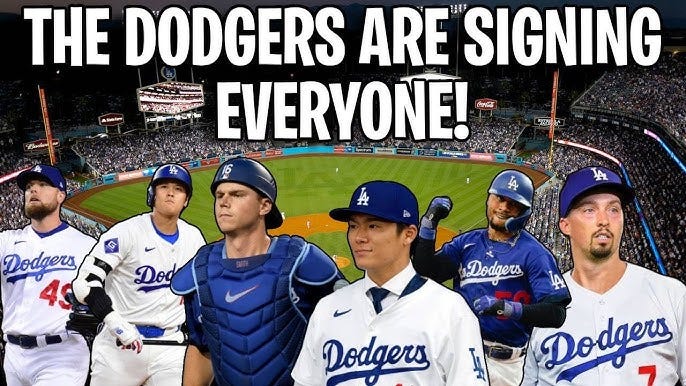
Tell me if this sounds remotely familiar: the Dodgers signed one of the best players in baseball to a record-breaking contract after having the highest payroll in baseball by a wide margin already. You could have typed out that headline any winter for the last five years and it would have been true which is why it’s incredible that it happened yet again, this time with former New York Mets closer Edwin Diaz whom they lavished with a 3-year $69 million contract. It’s the highest annual payday for a relief pitcher ever, and plugs one of the main holes the Dodgers had last year.
It’s funny that the Dodgers get to do this. They just won the World Series, which for many teams would be a signal to catch your breath and maybe even save some money since your fanbase will presumably be satiated for a while after the championship parade. Instead, the Dodgers went out and immediately tried to reinforce their relative weak spots in an effort to win three rings in a row. Speaking as a huge Dodger fan, this is cool and good. Speaking as a sports enjoyed, I think it’s wise and practical. Dodgers management knows that championship windows only move one direction, and whether they close slowly or slam shut is up to a mixture of luck and circumstance. Money provides a minor inoculation against fate. It’s no guarantee the Dodgers will win again, but having Diaz’s world class stuff on the team is better than him being somewhere else.
There are two odd things about the Diaz move, though. First, the Mets signed all-star reliever in Devin Williams away from the crosstown Yankees a couple weeks ago for 3-years and $51 million. Williams was lights out for several years until he got to the Bronx, which is a worrying development for the guy you’re spending that kind of money on. Unless you’re the Marlins or the A’s, the difference in annual value between Williams and Diaz is marginal. If you’re Mets owner Steve Cohen, the difference might as well be what you find your sofa cushion.
That brings me to the other weird thing about this signing. Why did the Mets let Diaz walk if money wasn’t an issue? Cohen has been clear that money is no object when it comes to bringing a title to Queens, so it’s strange to me that he’d be squeamish about a difference of less than $20 million for a reliever that is both better than Williams and beloved by fans. I had half a dozen Mets fans text me today wondering how this could have happened. I love having Diaz on the Dodgers, but it also seems like something else is happening.
Los Angeles’ extreme spending has led to a lot of wailing about a salary cap from parsimonious owners and crybaby fans. (If you’ve somehow read this far and don’t know that baseball is the only major American sport not to have a strict salary cap system, I commend you.) A cap has been a nonstarter for the MLB Players Association—the union that represents the league’s players, managers, and trainers—because it would lead to lower wages and weakened leverage for players who currently operate in an effectively open labor market. There are a ton of convoluted rules for younger MLB players, but once you accumulate the service time to become a free agent, you have incredible latitude on where you want to go and how you want to structure your contract compared to the other professional sports. That flexibility is bad for cheap owners: highly talented players often go to the teams with the deepest pockets and there are few benefits to staying put or codified hometown discounts to make it more attractive.
The Dodgers are held up as Exhibit 1 of how this free market system is ruining baseball, and the Diaz signing only adds credence to the case. If the Dodgers have a bottomless budget, the logic goes, then what’s to stop them from hoovering up every excellent player on the market and dominating the league for years to come and destroying competitive balance once and for all1? A salary cap prevents that doomsday scenario, while also ensuring that owners won’t have to compete in an arms race where they have to pay employees market wages.
This is all hypothetical and conjectural, but what if Cohen knew Diaz had an offer from the Dodgers and refused to match it in an effort to build the case for a salary cap? What if there was a tacit agreement among some of the other owners to not offer Diaz a contract and to let him go to LA? The current collective bargaining agreement—the contract that determines how the business of professional baseball operates—a year from now, on December 1st 2026. If the Dodgers win the World Series again and Edwin Diaz gets the final out to earn his ring, baseball owners might finally have their chance to force the issue of a salary cap once and for all.
I just want to poke a hole in this logic for a second: the baseball playoffs are notoriously random, and the idea that simply running out a superteam guarantees a World Series every year is silly. Players get injured, guys go into slumps. Case in point, the 2023 Dodgers won 100 games in the regular season and the Diamondbacks won 84. The Dodgers were 8-5 against Arizona in the regular season and then got swept in the playoffs by a World Series bound D Backs team.
it's so annoying how the other leagues worked out the competitive-balance stuff decades ago -- salary cap, salary floor, rookie scale, max contracts -- but the MLBPA keeps rejecting all of that as if every centerfielder were getting juan soto money.
but no one's making the marlins/pirates/white sox spend money, owners manipulate service time and collude against free agents, the minor leagues get cut. so the baseball suffers _and_ players get screwed; even the yankees and red sox claim poverty and let guys walk over what amounts to a rounding error.
i do think the MLBPA undermines its own leverage, but when the lowest payroll in the league can win 85 games it's kind of a baseball problem. i wish more fans would take a stand, like when hal steinbrenner says it's time for austerity measures everyone needs to be like actually no fuck you.
So if the Dodgers win the WS again it's because the baseball playoffs are "notoriously random", right?