

Modern life, modern love
A pair of NYT pieces on Verhoeven and sexual market value

A couple pieces of mine have come out the last two weeks that sort of reaffirm this blog’s thesis in that the internet and technology are mutating how we interact with the real way in ways that continue to disturb and surprise. The first is about the Dutch director Paul Verhoeven, who has directed some of my favorite scifi satires including Robocop and Starship Troopers. Verhoeven was such an odd figure in Hollywood—I say “was” not because he’s dead but because he left the US two decades ago and now makes moves exclusively in Europe—in that he was consistently given huge blockbuster budgets to make blockbuster movies but never wavered from his commitment to making fun of American society. The craziest part is that no one seemed to get it, regardless of how many times he made a film about rabidly violent technodystopias full of insane commercials. When Starship Troopers came out, the New York Times critic Janet Maslin had this to say:
‘’Starship Troopers’‘ looks like reason to wonder how the big-ticket exploitation film mutated into its present form. The movie for everyone is, in this case, only for everyone who likes raw meat for breakfast. Still, it certainly can pander, what with pretty actors, grisly critters, brains sucked out of skulls, buckets of green slime and a plot that is half beach blanket bingo, half Iwo Jima. Gung-ho patriotism is also big here, what with cries of ‘’The only good bug is a dead bug!’‘ and ‘’You kill everything that has more than two legs, you get me?’‘
No mention of the bluntforce satire that equates military service with full citizenship, or the manically laughing schoolteacher standing behind children stomping on roaches.
The piece I wrote for the New York Times Magazine isn’t about critics missing the point, though. I wanted to know why people keep pointing to Verhoeven as a cinematic clairvoyant and what that said about our ability (or inability) to deal with the conga line of nightmares our current reality has brought us. While I was writing, I kept coming back to the idea that Verhoeven is less a messenger from the future and more a source of comfort. His childhood was spent under Nazi occupation in Holland; his family lived near a V-2 rocket installation and Allied shellings were not infrequent. When he arrived in America, he looked at the gun-obsessed people and money-devouring system and decided to make his art about his past and present colliding. Starship Troopers is not Verhoeven trying to tell you where we were headed, but where we already were in 1997.
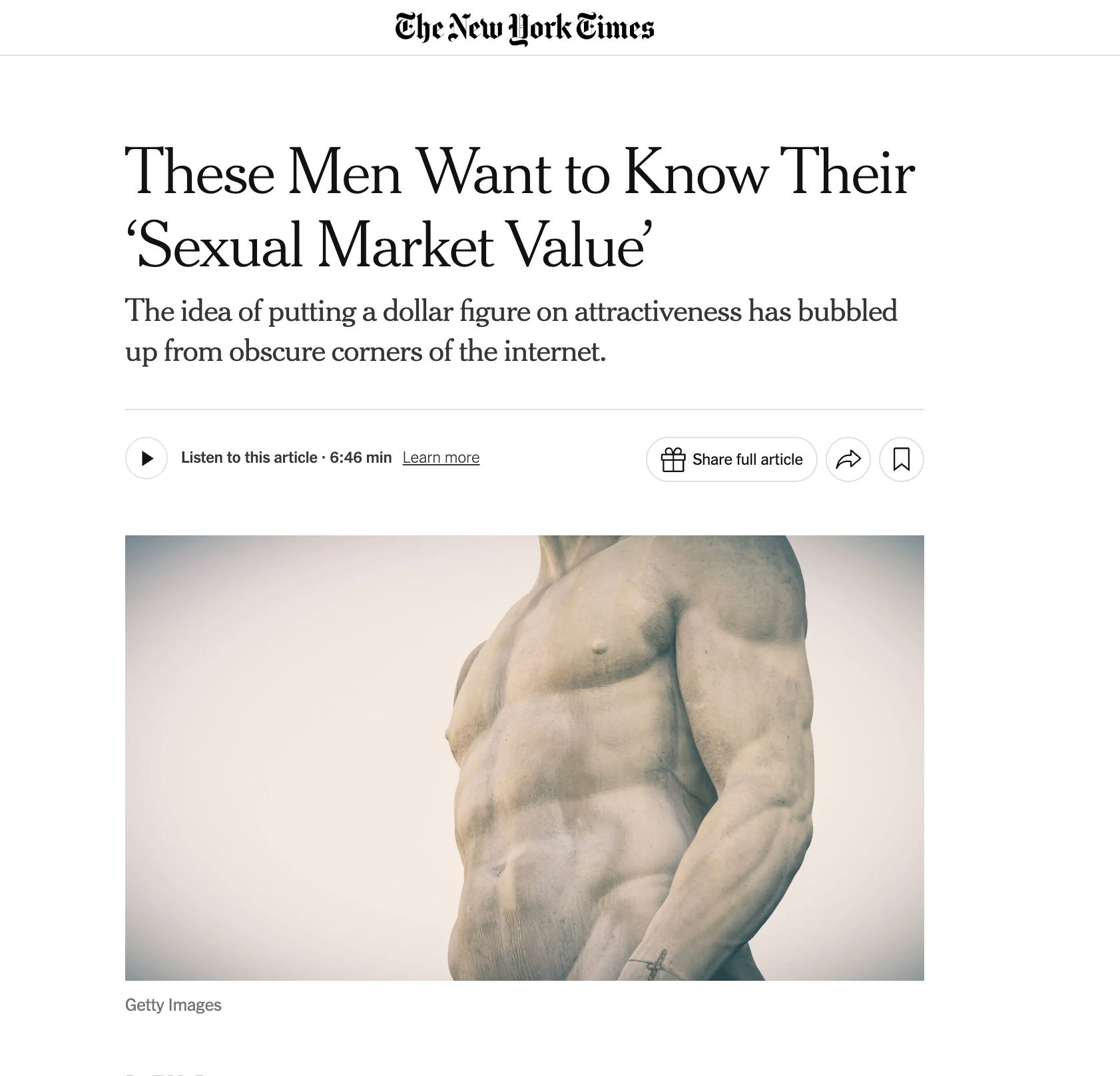
I have another piece out today that I realized explores some similar themes. It’s an investigation into the wide adoption of the term “sexual market value,” which attempts to grade men and women’s sex appeal on a scale. This backs into a topic I’ve spent quite a lot of time thinking about, in that there is this unabated march towards quantifying every aspect of our lives. Reporting this story out was depressing: there are so many sad young men out there who feel as they’re not good enough, that they need to climb some sort of ladder to be worth of love. It’s a topic I’m going to keep exploring as a writer, although one that is unfathomably sad.
Was it really that much easier to date in the 2000s? I can't ever imagine discussing this sort of thing with my guy friends back then. Maybe we need to start a "Swingers" revival? That was (for better or worse -- and considering where things have gone, I'm going with for better) a whole language for discussing dating for a whole generation of men. The point is to get Heather Graham, not impress Vince Vaughn!
I starkly remember watching "Robocop" and the commercials and news programs it depicted had a chilling effect on me - THIS is our frightening future?! It used to be that satire made fun of the current status quo, but in this case it was a Satire-Becomes-The-Future, and we've now seen it all come true in real time ("Idiocracy" was the other proof of concept here). In hindsight, I feel 2013 was the turning point when things started to get weird. And then I just remembered that the Mayan Calendar came to an end in 2012, and now discovered there is a whole Wikipedia entry on "The 2012 phenomenon":
https://en.wikipedia.org/wiki/2012_phenomenon#:~:text=Mayan%20scholars%20stated%20that%20no,misrepresented%20Mayan%20history%20and%20culture.