

Machine head
The temptation of AI writing

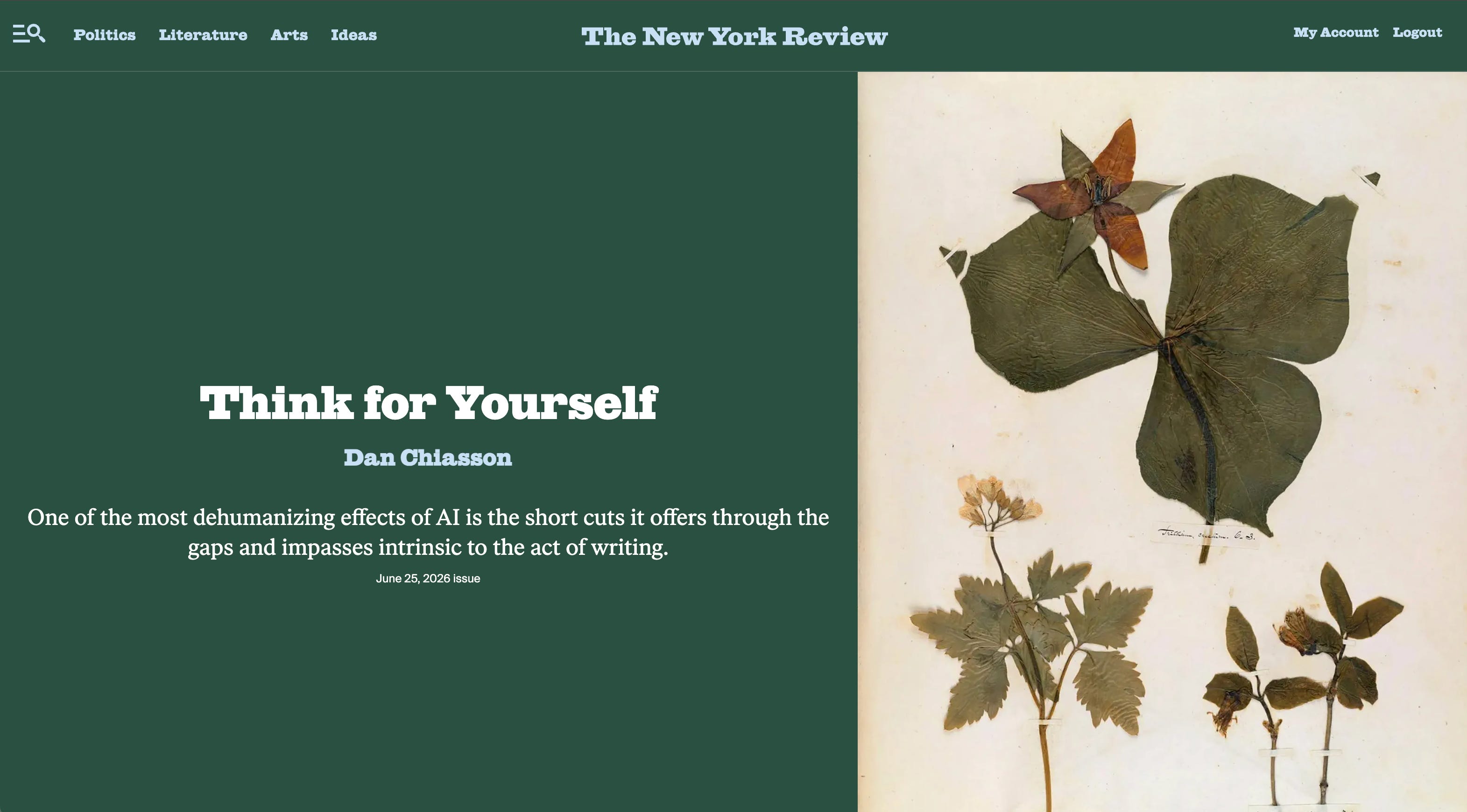
The worst thing about AI for me, personally, is that it indulges my impatience. For as long as I’ve been writing, I have been rewarded for waiting until the very last minute to do something which has created a thick webbing of neurotransmitters that I fear I will never snip. I was a very bad student, but I could maintain a B average without doing very much which was fine with me. I was good at standardized tests, much to the frustration of my high school teachers who saw my bad behavior being reinforced. At some point I think there was an actual term in the pedagogical community for teenagers like me: Slacker.
Those habits followed me like a shadow whispering “now, now, now” in my ear. Everything needed to happen in the screaming immediate. What was the point of waiting for something when it could happen much sooner? I get frustrated when fully woven ideas don’t hurl me forward like drawn sails. Even now, as I write this on a Sunday afternoon, I wonder when this will be done and why it won’t be sooner than it should actually take. I do not want to let my ideas breathe. What if that takes too long? A lot of my peers struggle with writing overlong, extending their ideas into currents that take them away from the main idea only to be reeled back in by an editor. I get tired at 800, 1200, 2000 words. Far more often than I like to admit, I get to the end of a piece far too quickly and have no way back. And like an embarrassed young man, I lie and promise that this sort of thing has never happened to me before.
So, then, LLMs present a sort of perfect temptation for me as a writer. At my previous job I was often asked to write engaging essays and blog posts—truly, if you want a definition of what the mercurial term “content” means, look no further than a tech company’s blog and you’ll get a solid idea—about topics I knew nothing about. The expectation was that I could use our enterprise-level Claude or ChatGPT accounts to get very quickly acquainted with, say, how salespeople identify tier 1 accounts or the role that GTM software plays in private equity portfolio company enablement, by feeding it documents on those topics and having it spit out an elementary summary. After that, I found that I didn’t need to write much at all. I could write a prompt and words would spool out like fishing line in front of me. Most of my job was editing. I didn’t need to understand what I was reading to make it sound good. The entire role was aesthetic in nature.
As soon as I figured out I could tilt the machine, all of my work started flowing through it. I would record interviews with colleagues on a topic that I knew I had to write about and pay scant attention to what they were saying because I knew that I would just take the transcription and query an LLM to create a blog post out of it. To be clear, this behavior, minus the “not paying attention” thing, was encouraged. We all did it; we were all told to do it. That’s how we moved fast enough to churn out pieces in hours rather than days or weeks. When I wanted to be honest with the people who asked me how I balanced the stress of a day job with my freelance career, I would say that the real time suck was meetings because I couldn’t hack them out of my schedule. It wasn’t that I was burning myself out writing twice as much by hand. One end was machine writing and the other was my human brain, frustrated that it couldn’t match the output of its artificial double.
I’m ashamed to admit it, but I stepped across that border once1. I was frustrated by my lagging pace in writing a book proposal, and late one night, sheepish as a peeping tom, opened a window in Claude and asked it to generate a few paragraphs that I had found especially directionless. I wanted to see if it could finish the section for me, and it did. Quickly. As fast I wanted my own fingers to run over the keys. I paused, guiltily. The paragraphs sounded like a tinny version of my own voice. I hated the ease with which those sentences formed. Can you envy a machine? For a moment that’s what it felt like. I deleted it all, feeling like I had violated some natural rule. I wished I could have burned it like paper.
That moment of dim indulgence was on my mind when I read Dan Chiasson’s essay in the most recent The New York Review of Books. Chiasson is a celebrated poet and the chair of Wellesley’s English department, where he crafted a remarkable statement regarding the use of A.I. in the classroom. In the essay, Chiasson uses the concept of delay, both physical and in a writer’s process, as a way of arguing for the value of human thought. He writes the entire essay in a day—appropriately on his friend Louise Glück’s birthday—starting in his bed before dawn and ending in the early afternoon. In the course of writing a few thousand words, he goes on a walk to inspect a patch of wild irises, goes on a run with his dog, and, I was heartened to hear, “scrolled,” “googled,” and “posted.” He wrestles with his own thoughts, in his own head, and bristles against the idea that such a process could be externalized, much less someone preferring it that way. “I would prefer not to write sentences that track their own emergence from thought,” he writes. “I feel I must actively preserve thinking as the medium in which language is generated, against Google’s satanic offer to “Help Me Write,” I also feel I should think about what it is I’m preserving, and who, exactly, the tempter is, and why they are so eager to “help me” surrender the pleasure of making the next associative or logical leap on my own, from hints and insinuations found inside a brain that can never fully know itself, or—sorry if this seems vain—tire of trying.”
Can you envy a machine? For a moment that’s what it felt like. I deleted it all, feeling like I had violated some natural rule. I wished I could have burned it like paper.
Buried in that single-sentence broadside are three words that we should pay attention to: “surrender the pleasure.” The joy of independent discovery—or “learning”—is something totally absent in my interactions with LLMs. It’s not that you can’t learn prompting Claude and reading its answers, but the route is so direct that you sacrifice any of the work that carves real thoughts into your brain. The same goes for asking an LLM for feedback, or for potential weaknesses or blindspots in your arguments. Outsourcing the struggle of “making the next associative or logical leap” to a machine brain strips the joy of being wrong from the process of making an argument. Are we so scared of making a misstep in an argument that we want a robot to check that we haven’t misinterpreted a passage or gotten indigestion from a book? Isn’t that part of how we learn? The idea that there is such a thing as an unimpeachable argument seems delusional, but some people seem desperate to find one anyway.
What about speed? There are twin pressures working at different altitudes, both of which Chiasson addresses. One is about the actual process of writing and thinking, which Chiasson beautifully illustrated through the different forms that delay takes. Emily Dickinson’s “little pools of saturated ink” where “she paused and rested her pen while gathering thought for her next astonishing turn. You can actually see the thinking, in those slightly darker splotches, and even estimate its duration—the darker the splotch, the longer the hesitation.” For Joni Mitchell and T.S. Eliot, “twenty or so years is not too long to wait for the inspiration to write lines” that stagger the heart. It gives me hives to think about my work in terms of years rather than hours or even minutes, but when Chiasson writes about the attempts Elliot refers to in the poem “East Coker” as “always thrilling, torturous, full of false starts and sudden advances, along with many little cliff-hangers within thought” my shoulders loosened. The pieces I’ve struggled against, where the pieces didn’t fit together no matter how hard I jammed them, were rewarding because they didn’t come easy. It’s not that the fight was its own reward, but rather that because I had to learn another way—and sometimes, an initial way—of thinking about what I was trying to say. Chiasson goes on:
“We know that human writing happens in time; we know from our own experiences and the testimony of many, many great writers that writing time is variable, plastic, marked by long periods of foundering and sudden adrenalized bursts; it pools and flows; it gets stoppered and unstoppered. AI offers us a way out of these gaps, empties, impasses, ‘new starts,’ and ‘different kinds of failures.’”
The promise of LLM writing is a sort of inoculation—or anesthesia if you like—against that failure, or, for the deluded, a permanent “adrenalized burst” of creaitivity2. To borrow Chiasson’s phrase, it is almost as if the machine would have us surrender the pleasure of finding out in exchange for never having to struggle again.
I’m not charmed by that compromise. I know that some people have said that those resisting LLM’s ability to streamline research are similar to the people who bitched about how search engines would destroy the edifying practice of going to the library to research the answers to a given problem or cut a path through a thorny argument. But where Google let people dig through digital stacks and take their own circuitous routes—rabbit holes and dead ends included—something like Gemini feeds you answers that others have already arrived at without needing to do any of the thinking it takes to actually get there all in a few moments. “The ‘knowing’ has been outsourced to a machine; we just retrieve the bits we want and leave the rest behind,” Chiasson writes. The answer an LLM returns to you does not actually teach you anything because even though you can outsource the thinking process, you cannot do the same for your own internal understanding. Some people have said there are ways to use LLMs that don’t fully denude our thinking process, and that learning how to cleave a line between “bad use of AI” and “good use of AI” should be the priority of any responsible user. But I also find myself skeptical of the idea that we can sift between those two piles so easily, that people will be able to identify when they’re thinking for themselves and when they’re not. I often found that even when I asked for feedback and other potential directions for a piece I was writing for the tech company blog, it felt like I was flipping to the back of a textbook and writing the answer down on my homework. “Whatever that is, it isn’t knowledge,” Chiasson writes. “[A]nd one of the truly astonishing things about this moment is the fact that so many people are perfectly happy to know so little.”
It reminds me of the story my father tells me about when he went out for his eagle scout badge as a teenager in Colorado. One summer night, the senior scouts in his troop blindfolded him and took him to a ridge in the foothills of the Rocky Mountains somewhere on the outskirts of Colorado Springs. He was left with a compass, flint, a pocket knife, and two eggs. (Part of the rubric for passing the test was to have cooked and eaten the eggs somehow. I still need to ask him how he prepared them.) The idea was that he would use the skills accumulated during his time in the scouts to get back safely to the troop camp a few miles away. The test was meant to be difficult but not prohibitively so, even though the area had a lot more mountain lions and bears back when it was a farming town than it does now. (It was also the 1960s and I think this kind of thing would probably be illegal now because of woke.) The knowledge he accumulated was meant to be deployed completing a single, complex task. You cannot write about something you don’t understand or have no desire to understand, and that understanding cannot be accelerated into oblivion no matter how much A.I. boosters want you to believe it.
To borrow Chiasson’s phrase, it is almost as if the machine would have us surrender the pleasure of finding out in exchange for never having to struggle again.
But why do we want to move so fast anyway? Chiasson finds there are larger things swirling alongside Dickinson’s ink-pooled pauses. “We now have accepted a brutal, capitalist model of time that represents passing moments as close-packed detonations of panic. A person either speeds up to stay ahead of these powerful blasts, or risks losing everything,” he writes. Anyone who has ever felt the compulsion to provide a take on something they don’t care about or had an anxiety attack over their lack of production can immediately identify with what he’s referring to. When I go through byline lulls I just assume that I have disappeared from the ledger of the world, much less my editors’ thoughts. LLMs can “solder the abyss” of those passing moments, but they do nothing to prevent the detonations from continuing like underground nuclear tests.
You can’t see them, but the breaks between those sentences and paragraphs were filled with pauses. I walked my dog. I met my wife for a drink while it was still sunny outside and people were wandering around deliriously happy about the Knicks game. I looked for suits on eBay. The blotted pauses on manuscripts aren’t enough to tell you whether or not someone stopped to think for a minute, it’s more a measure of trust. A friend of mine joked that the only way to fully convince someone you hadn’t used AI in your writing would be to set up a camera that watched you as you type, as a sort of stop-motion version of holding up today’s newspaper in a hostage video. The delays—walks, drinks, conversations, fights, years, disasters, weeks, deaths, births, ends, meals—would all be there at least, proof of the pauses.
Chiasson ends the essay with a quote from his friend Glück, with words I cannot hope to improve on so I won’t embarrass myself by trying. “It seems to me that what is wanted, in art, is to harness the power of the unfinished,” she writes. “All earthly experience is partial. Not simply because it is subjective, but because that which we do not know, of the universe, of mortality, is so much more vast than that which we do know.”
I apologize, specifically, to becca rothfeld !
This is a real thing, by the way. I’m not sure my editor and friend Michael Agger knows this, but the lone piece I wrote for him, a 3500-word reported feature on a techno museum in Frankfurt, was written during a sudden creative mania where I woke like a shot at 1am and wrote the entire thing by breakfast.
I haven't read Chiasson's piece (though I will), but I think you capture what I most appreciate about writing, that reminder of my own capacity to discover something. In a lot of cases I'm discovering things someone else already knows or that an LLM could surface if prompted, but that doesn't diminish that the thing I discovered is truly mine.
The question is where does this experience have value beyond the internal or sense of self-satisfaction? Art making, personal expression, self-discovery, for sure.
Because I've gotten older and because of how I've managed to arrange my life and work these discoveries have largely become the work itself, which I'm grateful for and which is why I'm never really tempted by that impatience to get to a result where an LLM might speed that process.
The other thing you illustrate is how the work of unique human intelligences are always in conversation with each other, sometimes implicitly, but also explicitly as in the case of this piece. You could've just allowed those thoughts to rattle around inside your head and that would've been great, but this is even better. And now, here's me adding on to the chain of conversation. Sometimes it feels like a miracle to me how this happens.
Great stuff!
Love this article. Reminds me of this from John Ruskin "The highest reward for a person’s toil is not what they get for it, but what they become by it"